
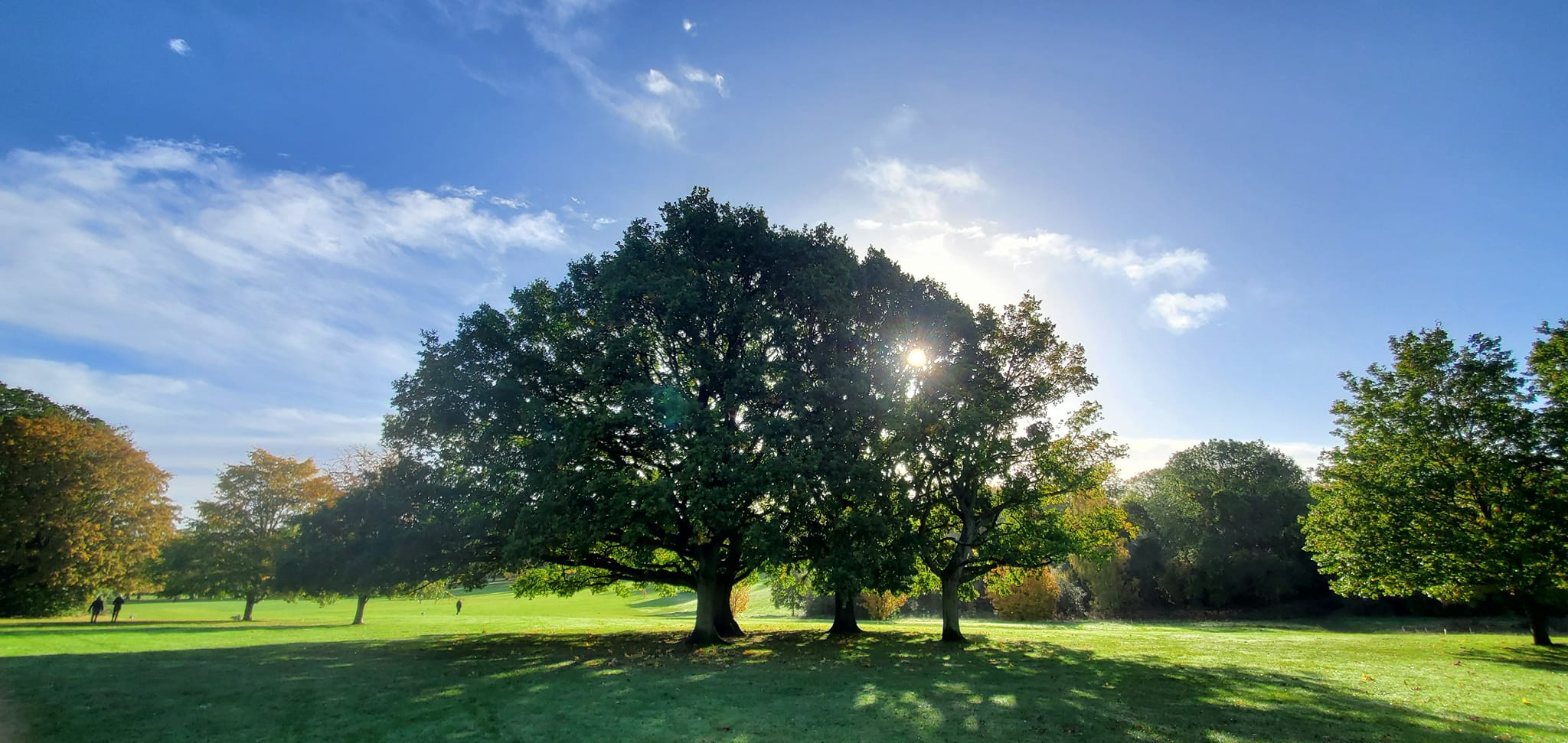

When we first arrived in the UK, a heavy, suspended sense of uncertainty hung over our daily lives as we waited for the local Council to allocate school places for my children. Not knowing which school they would attend or how the system would handle our application naturally bred a quiet anxiety. To soothe our restless minds, I often took the children to a park near our new home. Little did I know that this ordinary green space would deliver a profound shift in perspective—not just to me as a anxious parent, but as someone whose past career was deeply rooted in the field of botany.
The Shock of the Four-Storey Giants
Back in Hong Kong, particularly in the New Territories, my professional background allowed me to study and appreciate numerous registered “Old and Valuable Trees.” Yet, standing beneath the trees in a typical British neighbourhood park, I was struck by a sudden, overwhelming sense of awe.
The trees here were simply monumental to a city dweller like me.
These were majestic giants, easily towering four or five storeys high. What truly took my breath away, however, was not merely their height, but the uninhibited, magnificent spread of their canopies and the sheer density of their untamed branches. They stretched fearlessly into the sky, weaving vast, thriving domes of green.
This is a sight rarely seen in Hong Kong. There, the vast majority of trees are severed and broken by various “urban necessities”—cramped pavements, underground piping, or aggressive safety clearances following typhoons. We have become so accustomed to seeing “decapitated” or heavily amputated urban greenery that we have forgotten what a tree is genuinely supposed to look like when permitted to grow naturally from fertile, uncompromised soil.
The Illusion of Protection: A Botanical Subversion
In Hong Kong, trees are trapped in concrete coffins. Their root systems are suffocated beneath paving slabs, their crowns squeezed between neon signs and high-rises. Under the guise of urban management, any branch that dares to grow too lush is met with “preventative pruning,” leaving them exhausted, stunted, and unable to ever truly flourish.
In stark contrast, the British giants I stood beneath were granted vast lawns to breathe deeply. Centuries of respect for the land and non-intervention have allowed them to retain their historic rings and stand with absolute pride.
Glancing at my children playing beside me—at their own dawn of growth, also waiting for an uncertain future—this four-storey giant seemed to deliver a silent, profound realization:
Perhaps, letting go and allowing the seed to grow freely is the ultimate key to its robust flourishing, quietly brewing the power to change the world.
As parents, we are often far too eager to pave a flawless path and prune away any unique branches to fit rigid societal standards. We forget that life itself inherently possesses the wisdom to break through the soil and find its own way.
The Cruel Pruning of a Society
Yet, this realization stretches far beyond the boundaries of parenthood; it casts a sharp, cruel irony onto macro-governance and human institutions.
In certain corners of the world, regimes actively deploy the guise of “protecting society” or “maintaining order” to erect suffocating frameworks. They extend their regulatory grip deep into the lives of the populace, systematically restricting, managing, and ultimately stifling the growth of the younger generation and emerging civic spaces. Fearing any independent branch that deviates from the state’s prescribed blueprint, they ruthlessly sever the autonomy required for a society to diversify, expand, and proliferate.
What remains in those societies is a superficial, manicured uniformity—a false stability purchased at the tragic cost of the nation’s vital, creative life force.
Conclusion
We are always in too much of a hurry to prune life into compliant, predictable shapes, entirely forgetting that the greatest strength comes from untamed potential.
The Council’s school arrangements will eventually arrive in due course. But in the quiet sanctuary of this British park, the great trees taught me my most enduring lesson: whether raising a cherished child or governing a thriving society, the highest wisdom lies not in meticulous, authoritarian intervention, but in granting the boundless highway for life to branch out, run wild, and be free.